Medical Aesthetics Billing Software: Compare 5 Options
Compare five medical aesthetics billing software paths for insurance claims, cash pay, remittance, denials, reporting, service scope, pricing, and exit.
Reviewed by Abdullah Wasim. On November 3, 2026, our team analyzed first-party Google Search Console data for August 2 through November 1, 2026. The queries "medical billing software for aesthetic medicine" and "aesthetic billing software" produced eight impressions and no clicks. The first query averaged position 32.0 and sent all four impressions to the booking-software article. The second averaged position 49.3 and split four impressions between the broad buying guide and booking guide. Bing Webmaster Tools was authenticated for August 3 through November 1 and showed no matching billing query among 25 classic-search keywords. We reviewed the live sitemap, existing software cluster, and current search results before assigning the claim and revenue-cycle decision to this canonical.
We analyzed current official documentation from HHS, CMS, Pabau, ModMed, AdvancedMD, Tebra, and Nextech. Vendor pages establish documented capabilities, not independent performance. Search results established intent only. We did not open vendor accounts, submit claims, verify payer enrollment, inspect contracts, review coding, test integrations, or audit a clinic revenue cycle. Product scope, pricing, payer support, services, and terms can change.
We built the 100-point Billing Evidence Chain and 48-control worksheet as original procurement tools, not industry standards or reimbursement forecasts. AI assisted research organization, drafting, artwork, and code checks; our team reviewed the sources, logic, layout, arithmetic, and language. OpenAI ImageGen created the featured illustration without patient, clinic, payer, clearinghouse, or vendor assets. This is business education, not medical, coding, billing, reimbursement, accounting, tax, legal, privacy, security, payer, or compliance advice.
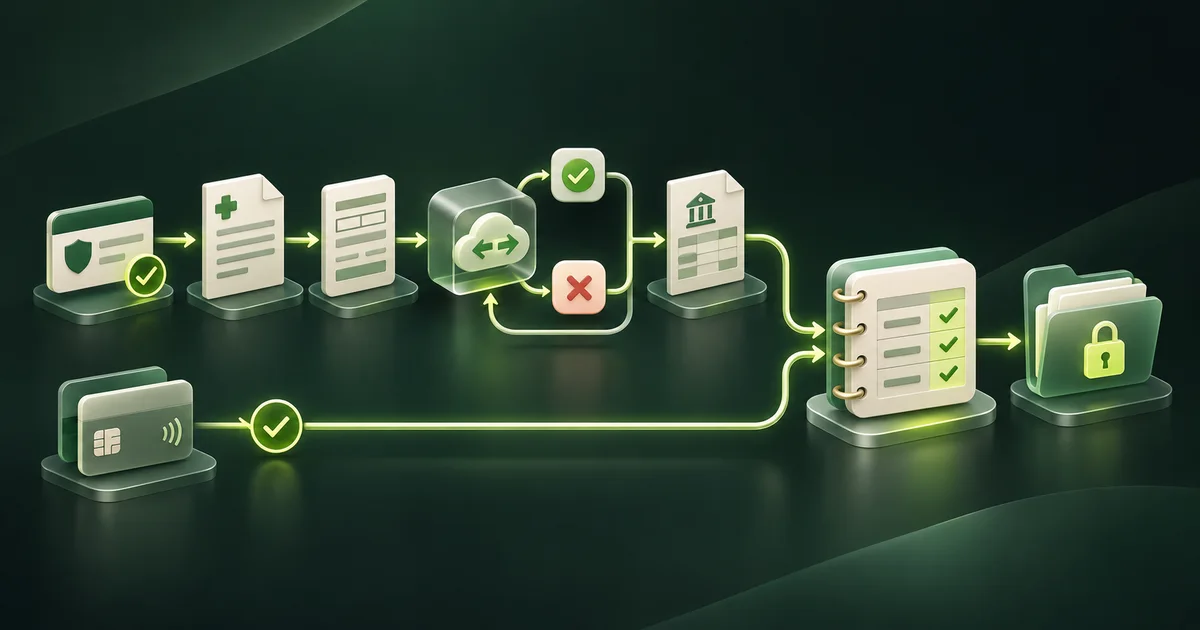
- Separate insurance claims from card processing. They may share a ledger, but they require different transactions, controls, reports, and contracts.
- Choose software by proving one de-identified claim and one cash-pay visit from intake through final reconciliation.
- Treat eligibility, claim acceptance, denial work, remittance posting, patient responsibility, reporting, and exit data as one evidence chain.
- Score the exact configured plan and service scope. A feature page cannot prove payer enrollment, staffing, implementation, or clinic-specific fit.
What is medical aesthetics billing software?
Medical aesthetics billing software is the system that manages the financial record around aesthetic and wellness services. For a self-pay clinic, that can mean quotes, deposits, invoices, card payments, packages, refunds, payouts, and reconciliation. For a clinic that bills insurance, the scope is larger: coverage checks, charge capture, electronic claims, acknowledgments, claim status, rejection and denial work, remittance, patient balances, and accounts receivable. Start with the clinic's billing model, not a vendor category. A cosmetic-only practice that does not submit insurance claims may need excellent patient payment operations but no medical claims engine. A plastic surgery or wellness practice with both self-pay and insurer-billed services may need two paths that meet in one reliable patient and financial record. The software must preserve which path applies, who made each change, and how the final balance was reached.
This guide owns the revenue-cycle decision. Use the payment processing software comparison for card authorization, deposits, refunds, processor settlement, and bank payouts. The medical aesthetics software buying guide covers the broader platform purchase, while the software infrastructure page explains the website and Portal boundary. Our editorial policy and About page identify our sources and team.
How is medical billing different from payment processing?
Payment processing is the movement of money through card, bank, cash, financing, or another patient-payment method. Medical billing is the workflow that prepares and tracks a request for payment from a health plan, then applies the payer response, adjustments, and remaining patient responsibility. One clinic can need both, but a strong checkout does not prove a usable claims workflow. The federal transaction map makes the difference concrete. HHS identifies the X12N 837 as the adopted electronic health care claim standard for covered electronic transactions. CMS lists 270/271 for eligibility, 276/277 for claim status, 277CA for claim acknowledgment, and 835 for payment or remittance advice in its standard transaction reference. CMS also explains that electronic remittance advice can support automated posting and carries payment and adjustment information in its remittance guidance. These references explain the transaction chain, not whether a service is covered or how a clinic should code it.
| Workflow | Primary question | Proof to request |
|---|---|---|
| Cash pay | Can the clinic quote, collect, refund, settle, and reconcile patient money? | Invoice, authorization, payment, refund, payout, fee, and bank-match records. |
| Insurance claim | Can the clinic create a valid claim and follow it through payer response? | Eligibility result, claim payload or form, acknowledgment, status, rejection or denial detail, and history. |
| Remittance and balance | Can payer payment, adjustments, and patient responsibility be posted correctly? | ERA or remittance detail, posting record, adjustment reason, patient statement, and reconciliation. |
| Hybrid visit | Can self-pay and insurer-billed items stay distinct without splitting the truth? | Item-level responsibility, two payment paths, one explainable ledger, and controlled corrections. |
How does the 100-point Billing Evidence Chain work?
Score each finalist from 1 to 5 in the seven stages below. Convert the rating to weighted points with this formula: rating divided by 5, multiplied by the stage weight. A rating of 4 in the 20-point claims stage earns 16 points. Score only behavior demonstrated in the proposed configuration and supported by the written order form, agreement, implementation scope, or service description. Download the original 48-control medical aesthetics billing software scorecard. Run it with sanitized test data and the people who will verify benefits, document the visit, create charges, work claims, post payments, answer patient questions, and reconcile accounts. A critical failure overrides the total when the clinic cannot identify a claim state, recover from an exception, restrict a financial correction, reconcile the ledger, retrieve required history, or exit with usable data.
Follow one de-identified claim and one cash-pay visit from eligibility and service classification through payment, reporting, and export. The weights total 100.
- Stage 1Payer and service fit15
- Demo test
- Map the clinic entity, provider, payer, plan, service, location, clearinghouse, enrollment, and patient-pay boundary.
- Full-score proof
- The written scope names supported transactions, payer dependencies, credentialing or enrollment owners, exclusions, and handoffs.
- Stop signal
- A general billing claim replaces a specific answer about the clinic entity, providers, payers, services, or required enrollment.
- Stage 2Eligibility and authorization10
- Demo test
- Run an eligibility inquiry, preserve the response, route an authorization task, and show how staff handle an exception.
- Full-score proof
- The patient, plan, date, result, source, staff action, attachment, and follow-up remain connected and time stamped.
- Stop signal
- Coverage information is copied into notes without its source, date, limitations, or accountable follow-up.
- Stage 3Documentation to charge15
- Demo test
- Move a completed, authorized record into charge review without asking software to decide clinical or coding judgment.
- Full-score proof
- The service, provider, location, date, diagnosis and procedure fields, modifiers if used, attachments, and reviewer are traceable.
- Stop signal
- A charge can be created, changed, or released without a source record, accountable reviewer, or preserved correction history.
- Stage 4Claim creation and submission20
- Demo test
- Create, validate, submit, acknowledge, reject, correct, and resubmit one professional claim through the proposed route.
- Full-score proof
- Validation, claim identity, submission time, clearinghouse response, payer acknowledgment, attachments, and resubmission stay linked.
- Stop signal
- Submitted, accepted, rejected, and denied are treated as the same state or a correction creates an unexplained duplicate.
- Stage 5Status, denial, and follow-up15
- Demo test
- Find a no-response claim, assign follow-up, record a denial reason, correct or appeal it, and preserve the outcome.
- Full-score proof
- Queues show age, amount, reason, owner, deadline, next action, supporting material, history, and resolution.
- Stop signal
- Staff rely on memory, spreadsheets, or payer calls that do not return to a controlled claim history.
- Stage 6Remittance and patient balance15
- Demo test
- Import or receive a remittance, post payment and adjustments, flag a mismatch, calculate patient responsibility, and reconcile.
- Full-score proof
- Remittance lines, deposit, claim, adjustments, patient balance, statement, correction, and ledger agree.
- Stop signal
- The clinic cannot explain an adjustment, underpayment, unapplied amount, patient balance, or correction from source to ledger.
- Stage 7Reporting, access, and exit10
- Demo test
- Restrict a financial role, inspect audit history, reproduce aging and collection totals, and open a representative export.
- Full-score proof
- Definitions, filters, source transactions, roles, retention, export format, attachments, fees, timing, and termination duties are documented.
- Stop signal
- Reports cannot be reconciled or the clinic cannot retrieve claim, remittance, balance, and audit history at exit.
Which medical aesthetics billing software options should a clinic compare?
The five options below represent different buying paths, not a ranked list. Pabau documents an aesthetic-practice workflow tied to Claim.MD. ModMed documents plastic surgery workflows that can separate self-pay quotes from insurance. AdvancedMD publishes a MedSpa edition plus in-house billing software and managed RCM. Tebra documents a broad independent-practice claims workflow but does not position the cited billing page specifically for aesthetics. Nextech publicly describes medspa billing and payments, while its medspa page does not establish the full insurance-claim chain. That last distinction is useful: the word "billing" alone is not enough.
| Option | Publicly documented fit | Commercial shape | Critical proof request |
|---|---|---|---|
| Pabau | US aesthetic-practice insurance claims through Claim.MD, plus remittance posting. | Software plus clearinghouse connection and related setup. | Show payer enrollment, claim states, attachments, ERA posting, patient responsibility, fees, and support ownership. |
| ModMed | Plastic surgery workflow with self-pay or insurance quotes, practice management, clearinghouse interface, payments, and optional RCM. | Platform modules plus optional payment and RCM services. | Run one cosmetic self-pay case and one insurer-billed case without merging their financial logic. |
| AdvancedMD | MedSpa edition, billing software, claims, electronic remittance, patient payments, and managed RCM option. | Software-only, bundled, encounter-based, or percentage-of-collections structures may apply. | Put every included module, service task, price unit, clearinghouse cost, implementation duty, and exit term in writing. |
| Tebra | Eligibility, charge capture, claims, rejection and denial work, posting, patient billing, and A/R for independent practices. | General medical practice platform and billing workflow. | Confirm aesthetic specialty templates, self-pay handling, payer route, service configuration, and the exact proposed product. |
| Nextech | Medspa scheduling, intake, billing, payments, memberships, and reporting are publicly described. | Medspa platform with payment terms in the agreement. | Require a live insurance-claims demonstration or classify the proposed use as patient billing and payments only. |
What should Pabau prove?
Pabau's current US insurance claims guide documents a prefilled CMS-1500 workflow, validation and submission through Claim.MD, claim history, batch submission, and distinct draft, ready, submitted, held, rejected, denied, and paid states. It also says electronic remittance can be matched to the invoice and post insurer payment. That public detail makes Pabau relevant to this shortlist, but it does not prove the clinic's payers, enrollments, attachments, fees, implementation, support response, or configured outcome. Ask Pabau to start before submission. Show payer setup, patient policy, authorization data, provider and location fields, and the rule that turns an insurer invoice into a claim. Then reject the test claim, correct it without losing identity, import an ERA, and explain patient responsibility. Confirm which work belongs to Pabau, Claim.MD, the clinic, and any outside biller.
What should ModMed prove?
ModMed's plastic surgery solution page documents custom quotes with a self-pay or insurance choice, practice management, a clearinghouse interface, an optional payment product, and optional ModMed BOOST revenue cycle management. This is a credible public signal for a hybrid plastic surgery practice because it acknowledges two financial paths instead of treating every case as either cosmetic checkout or insurance billing.
Test two sanitized cases. Move the cosmetic case from quote to deposit, payment, refund, payout, and reconciliation. Move the insurer-billed case from coverage and documentation to charge review, claim, acknowledgment, status, remittance, and remaining balance. Ask which modules and services own each step and whether the clinic can reproduce the ledger after corrections.
What should AdvancedMD prove?
AdvancedMD's current pricing page lists a MedSpa software edition and says core plans can include insurance and patient billing, claims management, electronic remittance, charting, a portal, and reporting. It also describes software-only and managed RCM paths. The same page publishes several pricing units, including per-provider plans, encounter-based options, and a percentage-of-collections range for RCM. Because the page contains plan tables and detailed FAQ terms that can change, use it to frame the quote, not to calculate a durable total from one number. Ask for two written scopes: the configured software and the human service. For each revenue-cycle task, mark clinic staff, AdvancedMD, clearinghouse, payer, or other vendor as the owner. Define what counts as collections, which payments or adjustments affect a percentage fee, what happens to old A/R, and which work is excluded. The medspa software pricing guide provides a separate 12-month cost, renewal, and exit model.
What should Tebra prove?
Tebra's billing and collections page documents eligibility and authorizations, charge capture, claim submission and management, rejection and denial work, payment posting, patient billing, and A/R management. Its ERA posting guide documents automatic posting support for several complex remittance scenarios. These pages establish a substantial medical billing workflow, not an aesthetic-specific recommendation.
Have Tebra configure the demo around the clinic's real specialty, entities, providers, plans, services, and self-pay mix. Show how a rejection differs from a denial, how each appears in work queues, and how an ERA line becomes a posted payment, adjustment, or patient balance. Confirm whether the proposed workflow is web, desktop, partner-managed, or a combination, and whether reports reconcile across those surfaces.
What should Nextech prove?
Nextech's current medspa page says Practice+ connects scheduling, intake, billing, payments, memberships, and reporting. That is relevant for medspa operations, but the cited page does not document eligibility transactions, professional claim submission, claim acknowledgment, ERA posting, or denial workflow. Do not fill those gaps with assumptions.
Ask Nextech to name what "billing" means in the proposed product. If it means patient invoices and digital payments, score it in the cash-pay path and use the payment workflow test. If insurance claims are included, require the full Billing Evidence Chain demonstration and written scope. Also review the current medspa agreement, which contains payment-services terms and a potential monthly non-use fee tied to a digital payment processing commitment. Confirm the order form, fee schedule, renewal, and exit before signing.
What should the contract and implementation plan settle?
A billing demonstration can pass while ownership remains unclear. The contract and implementation plan should identify the software modules, clearinghouse, payment provider, interfaces, payer enrollment work, implementation services, data migration, biller access, support paths, price units, minimums, renewal, termination, and export. If an RCM service is included, define its task list and exclusions rather than relying on the phrase full service.
Build a responsibility map for eligibility, authorizations, charge review, coding decisions, claim release, rejections, denials, remittance, patient statements, refunds, A/R follow-up, reporting, and reconciliation. Name the accountable clinic owner even when a vendor performs the task. Software cannot settle whether a service is covered, medically necessary, properly documented, or correctly coded. Keep those judgments with qualified professionals.
Treat implementation and exit as one lifecycle. The software migration plan covers sample exports, reconciliation, cutover, and rollback. The software security guide covers identity, roles, logs, incidents, backups, and offboarding. Require representative claim, remittance, balance, audit, and report exports before committing.
- Define whether old A/R stays in the legacy system, moves, or runs down in parallel.
- Name the source of truth for patient demographics, coverage, documentation, charges, claim state, and balance.
- List every interface, file, frequency, failure alert, correction owner, and reconciliation report.
- Separate platform fees, clearinghouse fees, transaction fees, service fees, implementation, migration, and exit costs.
- Set measurable launch gates for access, enrollment, test claims, remittance, patient statements, reports, and staff rehearsal.
What should a medical aesthetics billing software demo include?
Use one scripted, de-identified hybrid scenario. Start with a patient who has one self-pay cosmetic service and one separately documented service the clinic expects to submit under its actual payer and professional guidance. The purpose is not to decide coverage or coding during a sales call. The purpose is to expose how the proposed system keeps responsibilities, claim states, money, and corrections understandable. Run the script twice: once on the happy path and once with an eligibility exception, claim rejection, denial, partial payer payment, patient balance, correction, and refund. Ask a clinic team member to operate the system while the salesperson observes. Export the evidence, reconcile the reports, and record unresolved items in the scorecard. Then repeat the same script with every finalist.
| Demo moment | Action | Pass evidence |
|---|---|---|
| Before visit | Check eligibility, capture the source and date, and route an authorization exception. | Result, limitations, owner, task, attachment, and history stay connected. |
| After documentation | Create and review a charge without bypassing accountable clinical or coding judgment. | Source record, fields, reviewer, release status, and correction history are visible. |
| Claim path | Validate, submit, acknowledge, reject, correct, resubmit, deny, and follow up. | One claim identity, distinct states, reasons, owners, deadlines, and full history. |
| Cash-pay path | Quote, collect a deposit, check out, refund part, and trace the payout. | Invoice, authorization, payment, refund, processor, fees, and bank deposit reconcile. |
| Close and exit | Post remittance, calculate patient balance, reproduce reports, restrict access, and export. | Claim, ERA, adjustments, statements, aging, audit history, and usable files agree. |
FAQ
What is the difference between medical billing software and payment processing software?
Medical billing software manages insurance-oriented work such as eligibility, charges, claims, claim status, denials, remittance, patient responsibility, and accounts receivable. Payment processing software manages patient payments such as deposits, card authorization, refunds, processor settlement, fees, and bank payouts. A clinic may need both paths to meet in one explainable ledger.
Does every medspa need insurance billing software?
No. A clinic that operates entirely on cash-pay services may need strong invoicing, payment processing, package, refund, payout, and reconciliation tools without submitting medical claims. A clinic should confirm its real payer and service model with qualified professionals before buying an insurance-claims workflow.
Can one system handle cash-pay services and insurance claims?
Some vendors document both paths, but the clinic should test the exact configured plan. Run one cash-pay visit and one insurer-billed claim, then verify that payments, adjustments, patient responsibility, corrections, reports, permissions, and exports stay distinct and reconcile.
What should an aesthetic clinic test in a billing software demo?
Test a de-identified claim and cash-pay visit from intake through reconciliation. Include eligibility, an authorization exception, charge review, claim validation and submission, acknowledgment, rejection, denial, remittance posting, patient balance, refund, reporting, permissions, and representative export.
Need the website, Portal, and billing handoff mapped?
Bring one sanitized patient journey, your current software stack, and the billing boundary you need to clarify. We can scope where a custom Portal should connect without pretending to replace qualified billing or clinical systems.
Request a Portal discovery call